BABEL, the Basic Automatic B.S. Essay Language generator, is software created by Les Perelman and others [chronicle.com] at MIT. Perelman was a "Director of Undergraduate Writing" at MIT. He has used BABEL to generate nonsense essays and feed them to automated essay grading software. The BABEL output gets high marks with sentences like "Privateness has not been and undoubtedly never will be lauded, precarious, and decent." I think Perelman has a point here. Clever students will no doubt learn to game any such grading system to their benefit. Teachers must question what, if any, benefit an automated essay grading system has.
Back in 2005, Perelman discovered an excellent predictor of score [nytimes.com] on an SAT essay test. It was the length of the essay. No other variable he examined correlated nearly as well with the score. The top scoring essays had many factual errors, too. No matter, according to SAT. The writing quality depends not on the correctness of any facts, according to SAT. Perelman's advice for scoring well is to practice writing fast and make up facts. Perhaps the high scorers can land a job with Fox News?
A paper by Perelman in the Journal of Writing Assessment critiques automatic scoring of essays.

4 out of 5 flipped classroom instructors recommend this blog.
Showing posts with label education. Show all posts
Showing posts with label education. Show all posts
Thursday, May 1, 2014

Tuesday, April 22, 2014
Racial, Gender Bias in Mentoring
Heard on NPR Morning Edition today: the depressing results of a study done by Katherine Milkman of the Wharton School of Business and two others. The researchers emailed 6,548 faculty mentors at 258 schools pretending to be students aspiring to earn a PhD. All potential advisors received the same message; only the name of the sender was changed. NPR says the names were all different. The messages said in part "I really admire your work, would you have some time to meet?" Names were purposely chosen to distribute across racial and ethnic identities. All that was measured was how often the profs wrote back agreeing to meet with the students.
Women and minorities were less likely to get responses, relative to caucasian males, and less likely to get positive responses. Caucasian males obtained access 26% more often. Remember, the text of the messages was identical. NPR says the letters were "impeccably written."
Perhaps the most distressing results were that that the gender of the professor had no effect, according to NPR, and that the business professors discriminated the most in favor of white male names like "Brad Anderson."
Evidence Of Racial, Gender Biases Found In Faculty Mentoring [npr.org audio].
Women and minorities were less likely to get responses, relative to caucasian males, and less likely to get positive responses. Caucasian males obtained access 26% more often. Remember, the text of the messages was identical. NPR says the letters were "impeccably written."
Perhaps the most distressing results were that that the gender of the professor had no effect, according to NPR, and that the business professors discriminated the most in favor of white male names like "Brad Anderson."
Evidence Of Racial, Gender Biases Found In Faculty Mentoring [npr.org audio].
Monday, April 21, 2014
Hybrid Pedagogy
Earlier today I stumbled onto hybrid pedagogy, a website for the eponymous open access journal, while reading a post from Rebecca Schuman, a blogger at Slate who covers education. The director, Jesse Stommel, is an assistant professor at UW-Madison. Give their site a whirl if you're into hybrid learning and pedagogy.
Text Set for NSA Mass Surveillance
Text Sets are a tool teachers can use to scaffold instruction for struggling learners. They generally focus on one topic or theme and are a very useful tool for improving comprehension and literacy. Text sets popped into my head when I found this article about the NSA and its mass surveillance. The author does not use the term "text set," but that is what he's proposing to provide context for the journalistic coverage of the NSA following the revelations by Edward Snowden last summer.
Anyone familiar with the Snowden/NSA story has no doubt read an article in which a journalist has compared the NSA to Big Brother in George Orwell's novel "1984." It's a metaphor with legs (is that a meta-metaphor?). Mr. Berlatsky points out that 1984 is not a book that paints the most relevant picture of the current government-sanctioned surveillance of the citizenry. He argues that other works do. He even goes so far as to say that 1984 can "enslave thought." I think he may be referring to the phenomenon of journalists who repeat what other journalists have already tweeted or written, even after a statement has been found to be unsupported by the facts. On The Media is all over this case.
On to the text set, culled from the article. A caveat: this text set might not be appropriate for scaffolding.
Anyone familiar with the Snowden/NSA story has no doubt read an article in which a journalist has compared the NSA to Big Brother in George Orwell's novel "1984." It's a metaphor with legs (is that a meta-metaphor?). Mr. Berlatsky points out that 1984 is not a book that paints the most relevant picture of the current government-sanctioned surveillance of the citizenry. He argues that other works do. He even goes so far as to say that 1984 can "enslave thought." I think he may be referring to the phenomenon of journalists who repeat what other journalists have already tweeted or written, even after a statement has been found to be unsupported by the facts. On The Media is all over this case.
On to the text set, culled from the article. A caveat: this text set might not be appropriate for scaffolding.
- Phillip K. Dick, Do Androids Dream of Electric Sheep?
- Franz Kafka, The Trial
- Arun Kundnani, The Muslims are Coming
- Maureen F. McHugh, China Mountain Zhang
to which I would add these nonfiction works:
- Patrick Radden Keefe, Chatter
- Bruce Schneier, Secrets & Lies
- James Bamford, The Puzzle Palace
Sunday, April 13, 2014
Your Inner Fish
It begins in the city of Chicago, with a room full of human cadavers.
That's how the story begins.We are descended from fish. It's a scientific fact supported by mountains of evidence. Much of the evidence is written in our bodies. I'm talking about evolution, of course. There's a fascinating look at your inner fish hosted on pbs.org. It's a three-part video series hosted by Dr. Neil Shubin. I'm watching it via the PBS app on an apple TV. You can watch it on your computer in the web browser, or with the PBS app on a tablet.
Dr. Shubin discovered tiktaalik rosea on Ellesmere Island. Tiktaalik is a creationist's nightmare. He wrote a book about it, and now he's doing this great series on PBS. I can't wait to see episodes 2 and 3.

added 4/20/2014: Your Inner Fish passes the Bechdel Test. There are female scientists in this documentary, in one of the scenes we have two women who talk to each other about something other than a man. Also, there are some great visualizations, like when Dr. Shubin is standing on some devonian river sediments on Ellesmere Island and we watch as it is transformed into a stream bed teeming with life some 380 million years in the past. I could see how video like this would be great in a classroom teaching evolution or geology. The pbs.org website for Your Inner Fish even has a classroom guide. This is a great resource for science teaching.
Friday, April 4, 2014
Flipped Learning Guidelines
The Flipped Learning Network (FLN) has announced [pdf] a formal definition of the term "flipped learning" on March 12, 2014, Two things immediately catch my attention here. First, they do not say "flipped classroom." The other attention-getter is who is the FLN? It is interesting that they do not use the more common "flipped classroom" term. They take care to draw a distinction between flipped learning and the flipped classroom. Until I chanced upon this announcement, I was unaware of any controversy or distinction that involved a definition of the concept.
If you are unfamiliar with the flipped classroom concept, head over to youtube and do a search. Their are many videos on this topic.
The FLN bill themselves as a group of experienced flipped learning educators. Their website is attractive and well-organized. Aaron Sams is at the top of their board members page. I believe he is the creator of the flipped learning model of instruction.
The flipped learning definition is published under a Creative Commons Attribution-NonCommercial-NoDerivatives 4.0 International License, from the non-profit Creative Commons organization. Whoever the FLN is, they are clearly interested in openly sharing their ideas and standards. This is commendable. They do not want others creating derivative works of their standard, so they want to keep control of it. They also do not want others deriving works and selling them for profit. Having looked and worked in the education field, I cannot help but notice all the for-profit enterprises (ETS, MetaMetrics, textbook publishers, Pearson Education, Charter Schools, ad infinitum). But, as I scrutinize the FLN website, I notice ads at the bottom of the page. There's Pearson, Sophia Learning, Cisco, Adobe, etc. This non-profit organization has some deep-pocketed corporations backing them.
A tip of the hat to Casting out Nines, a blog that posted on this new definition.
If you are unfamiliar with the flipped classroom concept, head over to youtube and do a search. Their are many videos on this topic.
The FLN bill themselves as a group of experienced flipped learning educators. Their website is attractive and well-organized. Aaron Sams is at the top of their board members page. I believe he is the creator of the flipped learning model of instruction.
The flipped learning definition is published under a Creative Commons Attribution-NonCommercial-NoDerivatives 4.0 International License, from the non-profit Creative Commons organization. Whoever the FLN is, they are clearly interested in openly sharing their ideas and standards. This is commendable. They do not want others creating derivative works of their standard, so they want to keep control of it. They also do not want others deriving works and selling them for profit. Having looked and worked in the education field, I cannot help but notice all the for-profit enterprises (ETS, MetaMetrics, textbook publishers, Pearson Education, Charter Schools, ad infinitum). But, as I scrutinize the FLN website, I notice ads at the bottom of the page. There's Pearson, Sophia Learning, Cisco, Adobe, etc. This non-profit organization has some deep-pocketed corporations backing them.
A tip of the hat to Casting out Nines, a blog that posted on this new definition.
Sunday, March 2, 2014
Hyperreal Numbers and Calculus without Limits
Once upon a time, I stumbled into a hyperreal number field on the internet when searching for something related to calculus. Maybe I was calculating the volume of a Steinmetz Solid? The so-called hyperreals can be used to develop the calculus without limits. The claim is made that, perhaps, the use of "infinitesimals" is less confusing than the concept of the limit for struggling calculus students. In fact, there is a calculus text using this approach that one can download for free from this page. The author, H. Jerome Keisler, is a professor emeritus of mathematics at UW-Madison.
What are the hyperreals? They are an extension R* of the field of real numbers, which is usually denoted by R. R is a subset of R*. Without going in to too much detail, R* is obtained from R by adding in infinitesimals and infinitely large numbers. An infinitesimal number is infinitely small. What does this mean? For every real number a, a number ε > 0 is infinitesimal if -a < ε < a. That's it. In contrast, 1/ε is infinitely large (a "hyperinteger"). Conceptually, hyperreals are similar to complex numbers. However, unlike the complex numbers, they are depicted in one linear dimension, not a two-dimensional plane. The nitty gritty is all in Keisler's book. With the concept of the infinitesimal available, we can have the hyperreal quantity x + ε that is infinitely near x. This hyperreal x + ε can then be used to formulate the derivative, which won't be surprising to anyone who has studied calculus.
Here's figure 1.4.3 from Keisler's book. An "infinitesimal microscope" has been used to zoom in on the hyperreal number line:

The infinitesimal microscope is a captivating pedagogical concept. I claim that it's easier to grasp than the concept of a limit. Children learn about microscopes in grade school. Maybe they learn about it nowadays by zooming in on their iPads. In any case, R* is a useful mathematical concept that can be used to formulate the calculus without that ungainly Σ thing. All you need is a little ε guy. :-) Keisler's book provides more than 800 pages of evidence.
The history of infinitesimals is interesting. The epilogue [pdf] to the aforementioned calculus text lays out the story. Archimedes anticipated both infinitesimals and the ε, δ approach of limits in some of his proofs. In the 17th century, the modern calculus was developed independently by Newton and Leibniz. In his reasoning, Newton used both infinitesimals and the concept of a limit as well as the so-called velocity method. Leibniz used infinitesimals. So there were three competing methods for doing calculus: infinitesimals, limits, and the velocity method. Jumping ahead (see Keisler's epilogue for whole story), the first truly rigorous treatment of calculus was formulated by Karl Weierstrass in the 1870's. I believe it was Weierstrass who introduced the ε, δ notation that we still use today.
There can be little doubt that the limit approach is firmly entrenched in the current pedagogy. Other than Keisler's book, I am unaware of any other textbook that uses this approach. I never heard it in Altgeld Hall or Van Vleck. Mathematics teachers should be aware of this alternative approach and should consider using it to introduce students to derivatives and integrals.
What are the hyperreals? They are an extension R* of the field of real numbers, which is usually denoted by R. R is a subset of R*. Without going in to too much detail, R* is obtained from R by adding in infinitesimals and infinitely large numbers. An infinitesimal number is infinitely small. What does this mean? For every real number a, a number ε > 0 is infinitesimal if -a < ε < a. That's it. In contrast, 1/ε is infinitely large (a "hyperinteger"). Conceptually, hyperreals are similar to complex numbers. However, unlike the complex numbers, they are depicted in one linear dimension, not a two-dimensional plane. The nitty gritty is all in Keisler's book. With the concept of the infinitesimal available, we can have the hyperreal quantity x + ε that is infinitely near x. This hyperreal x + ε can then be used to formulate the derivative, which won't be surprising to anyone who has studied calculus.
Here's figure 1.4.3 from Keisler's book. An "infinitesimal microscope" has been used to zoom in on the hyperreal number line:
The infinitesimal microscope is a captivating pedagogical concept. I claim that it's easier to grasp than the concept of a limit. Children learn about microscopes in grade school. Maybe they learn about it nowadays by zooming in on their iPads. In any case, R* is a useful mathematical concept that can be used to formulate the calculus without that ungainly Σ thing. All you need is a little ε guy. :-) Keisler's book provides more than 800 pages of evidence.
The history of infinitesimals is interesting. The epilogue [pdf] to the aforementioned calculus text lays out the story. Archimedes anticipated both infinitesimals and the ε, δ approach of limits in some of his proofs. In the 17th century, the modern calculus was developed independently by Newton and Leibniz. In his reasoning, Newton used both infinitesimals and the concept of a limit as well as the so-called velocity method. Leibniz used infinitesimals. So there were three competing methods for doing calculus: infinitesimals, limits, and the velocity method. Jumping ahead (see Keisler's epilogue for whole story), the first truly rigorous treatment of calculus was formulated by Karl Weierstrass in the 1870's. I believe it was Weierstrass who introduced the ε, δ notation that we still use today.
There can be little doubt that the limit approach is firmly entrenched in the current pedagogy. Other than Keisler's book, I am unaware of any other textbook that uses this approach. I never heard it in Altgeld Hall or Van Vleck. Mathematics teachers should be aware of this alternative approach and should consider using it to introduce students to derivatives and integrals.
Wednesday, February 19, 2014
Spreading misinformation with a bladder
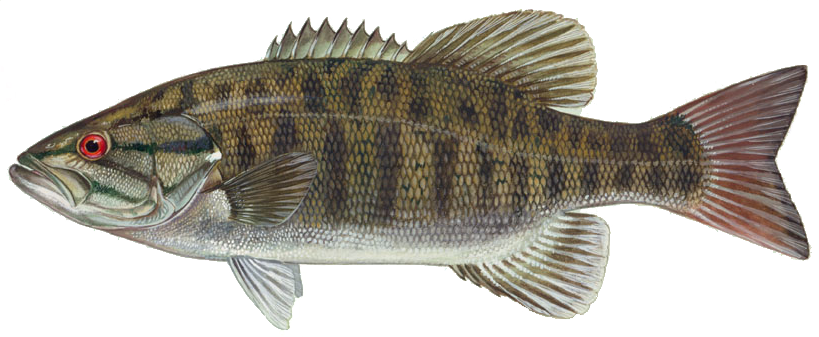
Ray-finned fish are know as actinopterygii. They are the dominant class of vertebrates; most fish species are ray-finned fish, if we're counting species. If we are counting individual fish, I suspect the actinopterygii would not be so dominant. This is one of my favorite ray-finned, fish, the smallmouth bass:

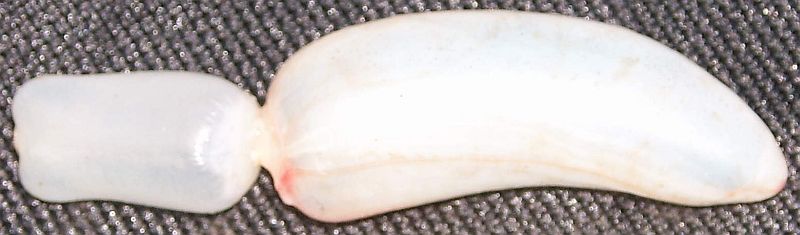
Ray-finned fish have an organ known as a swim bladder or an air bladder. Here is an image from wikimedia of an air bladder:

This organ in a ray-finned fish is homologous to the lungs of higher vertebrates such as apes and horses. So, why bother posting about the swim bladder? Because it is an object used to spread misinformation. It showed up in a class I participated in recently. The swim bladder has been used in a teaching method known as the discrepant event. Here is the discrepant event I became aware of:
So, when the swim bladder expands, gas molecules are brought out of solution in the blood of the fish, where they occupy essentialy zero volume, into the bladder, where they now constitute a volume with a density roughly 1000 times less than the density of water. The density d = M/V of the fish will decrease, since we have increased V with no corresponding change in M. The buoyant force on the fish will increase, causing it to rise. If the fish swims downward, where the external pressure on its body is increased, the rete mirabile can passively absorb gas molecules from the swim bladder back into the bloodstream to reduce the buoyant force.
Whoever wrote the nonsensical item I quoted above is not understanding the physiology of actinopterygii. Physiology fail, dude! I would question whether any living metazoan can create a significant vacuum within its body. Please comment on this if you are aware of an example.
I will close with one fascinating fact: swim bladders can also receive and generate sound. In many fishes, they can produce a sound like a grunt or a bark.
Ray-finned fish have an organ known as a swim bladder or an air bladder. Here is an image from wikimedia of an air bladder:
This organ in a ray-finned fish is homologous to the lungs of higher vertebrates such as apes and horses. So, why bother posting about the swim bladder? Because it is an object used to spread misinformation. It showed up in a class I participated in recently. The swim bladder has been used in a teaching method known as the discrepant event. Here is the discrepant event I became aware of:
True or false?This is unphysical nonsense. Unfortunately, it is easily found with a google search. The author has abused Archimedes' principle to reach the wrong conclusion. The first alarm bell is set off by the misspelling. More to the point, we have the statement that "air weighs more than the vacuum created when it is released." Really? A bass has an internal vacuum pump? The author is telling us that a bass can increase it corporeal volume and density using the swim bladder, that this bladder does double duty as a vacuum tank. I doubt it. Physically, a swim bladder is like an extensible bag similar to a ballon. The "air" (usually oxygen) in the swim bladder is created by a fascinating complex of arteries and veins known as the rete mirabile ("wonderful net") using countercurrent ion exchange. This is an excellent example of adaptation. I believe it also protects fish from "the bends" when they rise from the depths.
Sink or Swim Scenario
When a largemouth bass (Micropteras salmoides) [sic] takes air into its swim bladder from the gills, the fish rises in the water. When it releases air from the swim bladder, it sinks.
Students will likely answer that this is true; however, it is actually false because the opposite occurs. When air is taken in, a largemouth bass sinks; when it releases air, it rises.
The appropriate equation for this question is: D = M/V
(D = density, M = mass, V = volume)
When the fish takes air into its swim bladder, the fish’s density, or specific gravity, increases to above 1. The air weighs more than the vacuum created when it is released. Since the specific gravity of fresh water is about 1, the fish sinks. Thus, the fish is able to sink, rise, or suspend itself by changing its density.
So, when the swim bladder expands, gas molecules are brought out of solution in the blood of the fish, where they occupy essentialy zero volume, into the bladder, where they now constitute a volume with a density roughly 1000 times less than the density of water. The density d = M/V of the fish will decrease, since we have increased V with no corresponding change in M. The buoyant force on the fish will increase, causing it to rise. If the fish swims downward, where the external pressure on its body is increased, the rete mirabile can passively absorb gas molecules from the swim bladder back into the bloodstream to reduce the buoyant force.
Whoever wrote the nonsensical item I quoted above is not understanding the physiology of actinopterygii. Physiology fail, dude! I would question whether any living metazoan can create a significant vacuum within its body. Please comment on this if you are aware of an example.
I will close with one fascinating fact: swim bladders can also receive and generate sound. In many fishes, they can produce a sound like a grunt or a bark.
Tuesday, February 18, 2014
Randomness and literacy
The generation of random numbers is too important to be left to chance. Robert Coveyou
I banged my shin the other day. The bruise on my left tibia just below the knee is a painful reminder of this event. A distraction was provided by the phone ringing. I stood up, thinking about answering, and I smacked my leg right into the coffee table. The ringing of a phone is a perfect example of a random event. If it had not rung, would there be a bruise on my shin? Probably not.
Random numbers, randomness, and the generation of random numbers are important topics. Randomness is particularly relevant to current events because of its essential use in modern cryptography, which has been in the news lately with articles about Edward Snowden and the NSA. Embedded within a larger frame of mathematics, science, and current events, these topics can provide plenty of impetus for interesting conversation and mathematical diversion.
More to the point, I intend to discuss literacy in the mathematics and science classroom. What can we do to motivate students to learn mathematics? One technique I have used and will continue to use is critical literacy. The teacher can display, e.g., the text of a newspaper or magazine article that gets the math wrong, that provides an example of innumeracy. This text can then serve as a jumping-off point for a discussion of a proper mathematical analysis.
Another technique I find intriguing is the discrepant event. A discrepant event is a demonstration or a question with a surprising or startling conclusion. An attention-grabbing event can be used to initiate the process. The discrepancy creates a cognitive springboard and forces the students to think about the subject matter. An example of a discrepant event was provided to me recently. A question was posed about fish bladders, an organ possessed by ray-finned fish such as the largemouth bass, Micropterus salmoides. I intend to expand on this topic in a later post.
A closely related technique is the thought-provoking question. How many years is one billion seconds? How many cells do you have in your body? These questions can provide a nice stimulus for a lesson and get the gears turning in the student's heads. Each of which has hundreds of thousands of hair follicles, of course.
Literacy can be used in the classroom to motivate, to captivate, and to initiate discussions. Mathematics is a complex topic, and motivating young students to learn can be challenging. It behooves us as teachers to have many arrows in our educational quivers.
Subscribe to:
Posts (Atom)